Thursday, 4 July 2019

Biting Dust

So, you say you're a runner. Then surely you can complete a loop of 6ish km within the hour. In fact, you'll have enough left in the tank to do another loop exactly one hour after you started the first. And sure, a third and fourth loop won't be that hard.

You're a marathoner. Surely you could do seven of these loops. Roughly 42 km and you get a whopping seven hours to complete it. Easy, so you should be able to go even further. But how far can you go? At what point will you be so exhausted, either as a result of the kilometres you ran or caused by a lack of sleep, that you no longer can run the 6 km loop within the hour. That's the question Another One Bites the Dust asks to its competitors. And I was curious to find out what my answer would be.

To reiterate, this is no regular ultra. Instead, every hour we have to start the same loop again. Official distance 5,959 km. In reality a bit longer (my watch measured it as 6,3 km), as is apparently a tradition with the organisers: Stef and Tim of Legends Trails. You don't have to be fast (just average at least 6,3 km per hour, preferably a bit faster so you have time to recover and eat before starting the next loop), you have to be stubborn enough to keep going.

It's a bit of a diabolical concept, really. Designed to break a runner either physically, mentally, or both. Unsurprisingly, the first race of this kind, Big's Backyard Ultra in Tennessee, is hosted by none other than Lazarus Lake of Barkley Marathons fame.


My goal

Mostly, I came to learn. I was interested in this type of race as soon as I first read about Big's, and when I found out about this 'local' (two hour drive) race I knew I had to try it. When I first discovered it in 2018, however,  it was two weeks before the start. Too late to enter. This year all my training was focused on a fast Seven Hills, but I didn't want to wait another year so I signed up for AOBtD anyway. Even without specific ultra training, I was sure I could last for a decent amount of loops and test my limits.

My approach to ultra has been conservative so far. All races I started I knew that I had a very high chance to finish. As a result I wasn't really sure about my limit as far as distance is concerned. My furthest so far, 70 km at Olne Spa Olne last year, went reasonably well. Surely I could go further, but how far? This should be a rather risk-free way to find out.

With what I knew about ultra's, I figured a few things:
-Eat a lot, you'll need the fuel. Don't wait 'till your hungry as you'll be too late.
-It's very much a mental game. Especially in this event where speed is less important.

So my prep involved bringing a lot of food (you never know what you'll crave, and the aid station at the start/finish might not serve it). And mentally I convinced myself I was going to win. Deep down I knew that wasn't realistic, but I didn't want to set another barrier. The event hands out medals to anyone who does 28 loops or more, and looking at the results I noticed many dropped out at exactly 28 loops, when this goal was achieved. My goal was to go as far as I could, I didn't want to have a finish line, not even one I was unlikely to reach.

Finally, I was curious to see how better runners than myself would tackle this event. And with another start every hour, they wouldn't be out of sight all the time.

Registration was as simple as writing down my name on this startlist


The Loop

After going round a few times, I had divided the loop in five sections. First, the easy road: tarmac then concrete. Running between some meadows until a left turn after a lone house. Next section was a single track, running between tall grass. I was glad we started with about 100 runners, as this meant to track was a little wider after a few rounds. Third section started with a cobblestone road, then onto some forest tracks (one of the few bits in the shade). It ended with a small climb. Nothing spectacular, but after two loops I decided to walk this uphill to conserve energy.

After the climb we were rewarded with a false flat downhill over tarmac. Then a left turn onto a tractor road. Sector five, by my reckoning, started with a right turn onto a grassy path. Then a narrow bridge (more like a balance beam as far as I'm concerned) and some off road through the meadows, ending up at the path we started on. Enough variety, not overly hard but very uneven (plus loose rocks) so you had to pay attention to your footing.


The Race

We started at 8 p.m. and it was still quite warm. Drank a lot, got familiar with the route and its characteristics, and tried to run at an easy pace. The bit with the tall grass I alternated running and walking, mostly because that's what those in front of me did. Didn't really like it but overtaking was nearly impossible here and would cost even more energy. Third loop I brought my headtorch after seeing others lining up with them at the start. Didn't really need it yet, but the fourth loop I never switched it off.

Also, we got burgers after loop 3

Fifth loop I wore a warmer shirt (long sleeves), as it got a bit colder. My stomach was a bit full, I could hear water splashing around as if I had my reservoir with me. Tried to tone down the drinking a bit. After the sixth and seventh loop I readied some food and gear for a little plan I had hatched. With the warm weather I knew I wouldn't be able to sleep during the day, so I wanted to try a little nap in the night time. After a fast loop 8 I went to my tent and laid down for 12 minutes. Wasn't tired enough to sleep, so I'm not sure if I actually came out on top here (the fast loop cost some energy).

After resting I grabbed everything I had readied and went for the start of loop 9. One mistake I did make was to bring an empty bottle, so I did this loop without any water. At 4 a.m. it wasn't all that warm, so I got away with it. Still goes to show how you can mess up these small things. It was a nice loop, with a spectacular sunrise.

Post loop 10 I decided to switch my shoes and socks. My left foot looked a bit battered. Dewdrops had clung to the tall grass and got my feet wet. On the left this resulted in what felt like a blister forming. Not much to do other than drying my feet and getting into clean socks. After ten loops in trail shoes I switched to road shoes. The course was dry (worst of the dew over) and didn't require extra grip. Especially in daylight it wasn't overly technical.

Legs felt fine. Some tiredness but I had over 60 km done. End of loop 10 and during loop 11 I did have some dizziness. By walking a bit and downing some jelly babies I fixed this. Not sure if this was really the miracle cure I needed, but I wasn't dizzy for the rest of the race. This did start a new pattern for me: walking the first bit of the tarmac road (start of section 4) and eating some. It was easier to eat while walking and I could afford to lose a minute there (most loops were between 40 and 42 minutes, so I had plenty of time in between rounds).

Loop 12 was special for me, passing the 70 km mark I now ran farther than I ever had before. Unfortunately, I also started to struggle a bit more. Legs were tiring, my left foot hurt at times and it was becoming harder to eat properly (just small bites). Still managed to get a good lap time, but it didn't feel great. The running of loop 13 felt slightly better, but afterwards I felt worse. Changed into a fresh set of clothes (underwear, different shorts, and now a sleeveless shirt).

Nevertheless, loop 14 I didn't improve. At this point I realised the endgame had started. More walking, and a loop time over 45 minutes. Little less rest, and I had trouble eating so I knew that tank would be empty in a few loops. Despite not wanting to set a limit, I had calculated that we'd pass the 100 km mark in loop 17. Even with my legs hurting more, I could definitely still make that.

So loop 15 and 16 I completed in crunch mode. Walking quite a lot but by running just the few parts where I felt strong I could compensate plenty. Loop times went up, bit over 47 minutes and a little under 51. Though really, I was also very much losing the race mentally. It just wasn't very fun anymore, hadn't been for hours now.

Beforehand I had one rule for myself: never quit in camp (I got this from John Kelly). Plus I wanted to go past 100 km now that I was so close (at 6,3 km per loop I was actually at 100,8 km already, but I used 6 km to be safe). So I started loop 17, walking more than I really had to, hoping to finish just under the hour. Ideally, I would sprint the last part to heroically make it, then miss the next start due to not having any time left.

While thinking this over, I had to admit that mentally I was broken. Even though I had set out to push myself, now that I'd been out there for over 16 hours, I just didn't want it anymore. So walking the last stretch towards the finish line, I was almost disappointed I still had over five minutes to spare. Nevertheless I knew I'd quit, accepting defeat in the mind game this race plays with you. I even mentioned this to another runner. Glad I did, as he pointed out we had plenty of time for another loop. In fact, he'd carry on until he'd be timed out.

It reminded me, that's what I wanted. That's what I came here to do. No way I could quit with five minutes to spare. I could drink, eat, and get ready. So I did.

From the start of loop 18 I walked, as I had the last few loops. This time, I couldn't really be bothered to start running. The previous round had taught me that with very minimal running, I could make it, and I wasn't sure if I even wanted that. After a while I did pick up the pace, and noticed I was going at about 6,5 km per hour. A new challenge presented itself. Could I walk to whole way and still finish in time?

Walking as fast as I could, I went for it. The small climb I figured I lose a little time, but even there I noticed I was going fast enough. At that point I knew I wouldn't have to run a single step. With two and a halve minutes to spare, I made it.

In a weird way, I found this was a good reason to quit. If I could even make it while walking, then really my only way out of this was to quit in camp. Sure, if I kept walking my laps I would eventually encounter something major. Perhaps my left foot would deteriorate so much I couldn't use it anymore. Or the lack of fuel in my stomach would put a halt to my efforts. In any case, I wouldn't want to be away from the camp once that happened. So I accepted defeat.

DNF after 18 loops

Postrace

Some regrets about quitting, even though I got quite far and was happy with the distance. But still, I actually felt pretty good walking and perhaps... I suppose there's always a lingering doubt, especially after the pain and exhaustion subsides. Fact remains that I hadn't eaten properly for the last few hours, so even the walking pace wouldn't be sustainable for much longer. Plus I was quite tired, a few laps I had trouble keeping my eyes open (especially with the sun out).

Unfortunately, the warm weather had turned my tent into a sauna so I hardly slept. Just got a little shut-eye on a blanket in the shade. Hanging out there meant I got to meet some nice people who were supporting Jack, a runner who was still in the race. After a while I found myself helping out a bit as well, fetching water and other drinks. Jack made it to 28 loops, which got him a "participation medal" and watching him in between loops taught me a few things about ultra.

As expected, the medal at 28 loops was a finish line of sorts to most runners still in the race. Only one, Merijn, opted to go for loop 29 and thus won the race. It was inspiring to see how deep these runners could go and I was happy to be around. Atmosphere at the camp was great, which made the waiting time pass rather quickly. Still, when I return to this event, it won't be for the camp. It'll be to run 6,3 km. And again, and again, and again...

Sunday, 23 June 2019

Two Foggy Munroes

Two Foggy Munroes

On the Tuesday after the Seven Hills, I went for a slightly longer run. If you just read the race report: I'll be a bit more brief this time and mostly share pictures.

The Route
My plan was to start in Strathyre, go to Stùc a' Chroin via Creag a Mhadaidh and Beinn Each, then make a small loop over the summit of Ben Vorlich back to Stùc a' Chroin. After that mostly downhill to Callander, where I was staying.

For the first part of the run I consulted the route of the Stùc a' Chroin Hill Race, though I opted for a more gradual ascent over forest roads to start with. Hill races have a tendency to take a direct line to the top and I prefer to start with less steep climbing to warm the legs up first.

The navigation went quite well. I did lose sight of some of the paths I was on, but looking back I never deviated far from my intended route (which I had loaded into my watch).


Creag a' Mhadaidh
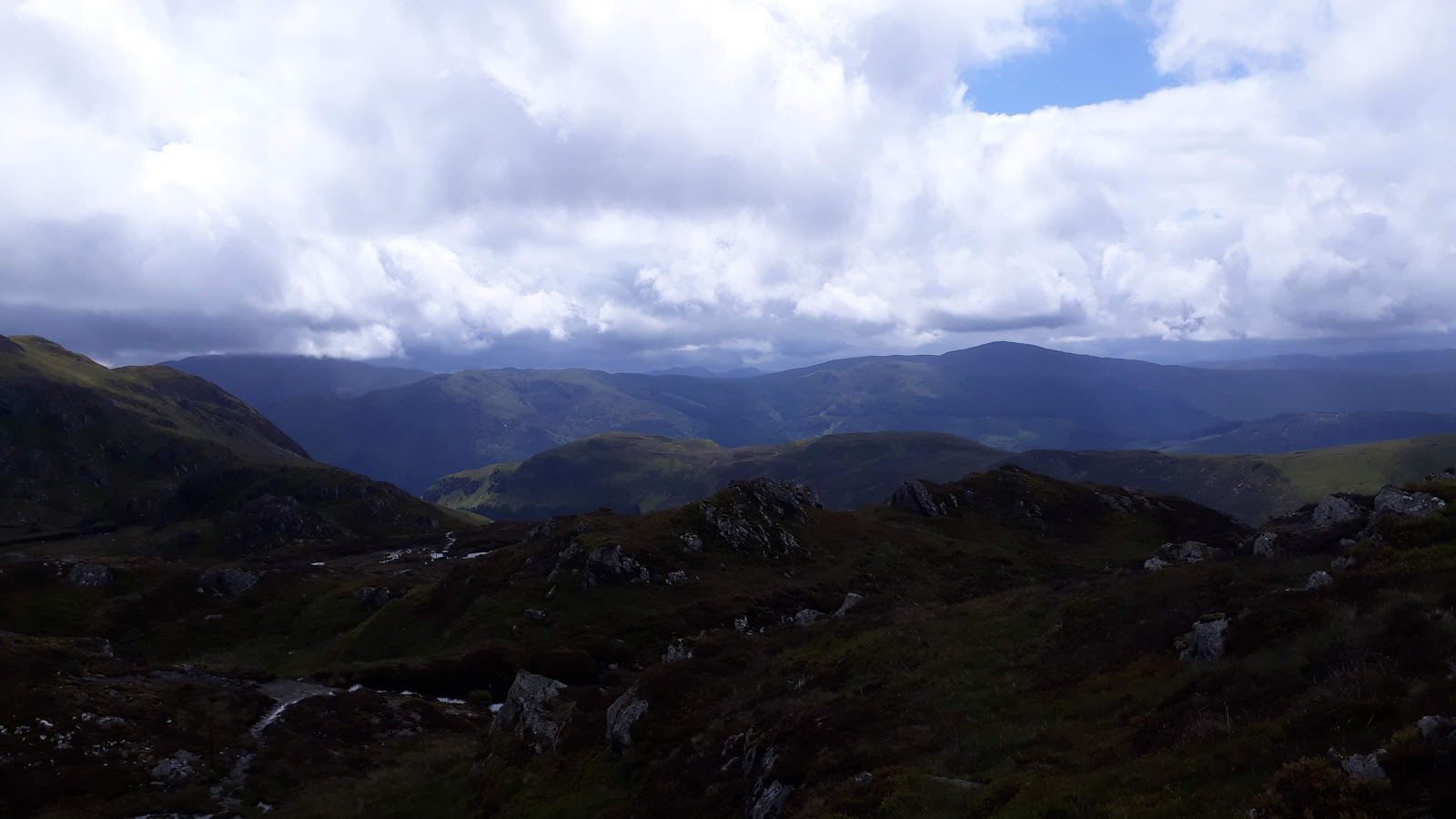
Not sure if this peak is well known or not. Spotted the name on the map and I would pass it regardless. Most of the rain had passed when I started at noon, just some drizzle here and there. Mostly though the paths were wet and surrounding vegetation made it impossible to keep my legs dry. Also: fog.

 Nice gradual ascent to start with

Might be where I'm heading, hard to tell in the fog

After a while I had to leave the easy wide road, and took a narrow path towards a fence. From then on I could follow the fence and do a little off road to the top of Craeg a' Madhaidh. Still fresh it went quite well and just under one hour I reached my first summit of the day.

Creag a' Madhaidh


Not sure if this burn above was supposed to be the path, perhaps I lost the way altogether. The downhill quickly became off road for me. I knew there was a wider path at the bottom, so it wasn't worrying. Just meant it took me a bit longer to descend as the wet grassy slopes were quite slippery.

First sheep of the day

Looking back during one of the less cloudy moments


Beinn Each
Not sure why this one is named "Beinn" rather than "Ben", but to each their own I guess. Very steep uphill with an easy to miss path. So I found myself a bit lower than I should be and did a wee scramble to make up altitude.

Off path here

But it did offer a nice view

Not able to run the steep bits I noticed a butterfly
(inspired Peter Buchanan)

Higher up the path was a lot more visible and I made my way to Beinn Each. Noting that the summit of Stùc a' Chroin was covered in fog, I enjoyed the views I had as much as possible.

Clear and visible path, no problems here

Stùc a' Chroin

Spectacular views are hard to capture with a (phone) camera

Stùc a' Chroin (1)
No major navigational errors on the way to Stùc a' Chroin. Even though at some point it was hard to see more than a few feet in front of me.
Technical path, yet easy to follow


Frog didn't dare to move. Thought himself invisible.


Looking back to Bein Each

Summit!

Over three hours in, this dog walker was the first person I encountered

For some reason Stùc a' Chroin gets two cairns

Ben Vorlich
Next stop was to be Ben Vorlich. The whole run (if I could still call it that, as I'd been moving rather slowly) was taking longer than expected, but I didn't want to miss out. Legs felt fresh enough, I mostly lost time by missing paths or taking extra care on slippy parts. So when it turned out I had good reception on the top, I texted my friends that I'd be late. Glad I didn't shorten my route, as I wouldn't have wanted to miss these sheep in the fog.


After a steep downhill scramble got me out of the fog, I went back in climbing Ben Vorlich. My second munro of the day and the highest point I would reach.

White stripe running through various part of rock 


Rather chilly up there so I donned my new hat.
Almost lost it due to the wind.

"I searched up on the mountaintops, it wasn't there"

Stùc a' Chroin (2)
On the way back to Stùc a' Chroin I passed another walker. Only the second person I saw after roaming the hills for almost five hours. It wouldn't be until I reached a farm road that I'd encounter more people.


Why hello there

Still foggy on the Stùc a Chroin summit(s)

It was mostly downhill from here. In a good way. Finally I could run at a somewhat decent speed again, and I was keen to make up some time. Dinner was calling. I had plenty of food with me, but craved a warm meal.


The last bit was rather uneventful, over tarmac. Roads I was already familiar with, as we walked there the day before.

In the end it took me 7 hours and 10 minutes to cover a little under 34 kilometres. Might have been more of a walk than a run. Doesn't matter, I have seen a lot of the hills and enjoyed pretty much every moment of it. The fog may have blocked some views, but also added some mystique to it. Hardly any rain, a great day out.

---
Link to Strava (moving time under 5 hours, without really long stops, meaning I was too slow for it to count as moving at various points).

Saturday, 22 June 2019

Seven Hills 2019

Seven Hills of Edinburgh 2019

In 2009 I first participated in the Seven Hills of Edinburgh. After finishing in 2:34:59 I told a friend that, one day, I'd complete the race in less than 2 hours. We made a bet out of it and set 2019 as the deadline. Over the years I trained hard and got better, resulting in a decent 2:03:27 last year. This year, however, nothing over 2 hours would be enough for me. Here's how it went.


The Training

Living in the Netherlands, I often get asked how I train for the hills. Perhaps I'll get into more detail in another blog (if this indeed does turn into an actual blog, not just a place to post this race report). The short version is we have an artificial hill near my hometown Rotterdam. Just under 100 feet in altitude. That's where I do hill reps. Training options are obviously more limited than in Scotland, but it's far from impossible to prepare yourself for hills when living in the flattest part of a flat country. You just have to make the most of what you do have.

The view from my training hill


As much as the Seven Hills race is an obsession for me, I don't want to come over for just the event. Scotland has much more to offer, and this year we (I always bring a group of people over, we're the "Dutch friends" referred to on the website) decided to do the Black Rock '5' as a warm-up. Really fun event on a challenging course. To save my legs a bit I didn't really race it, just made a bit of an interval training out of it and enjoyed the atmosphere. Despite that I still ran faster than in 2017, when I did try to go as fast as I could (but admittedly was in a bad shape). Good boost of confidence ahead of d-day.

Saturday we often visit parkrun, but I was still saving my legs so I opted to volunteer instead. Ever the tourist, I did jog up and down to Cramond Island for a few photo's with Matt and Robin, who did choose to run the parkrun.

Tide was just right to get across before the parkrun started


My final prep was the barbecue in the evening that Alan (Seven Hills organiser) hosts for both the volunteers and the overseas competitors. The way he makes us feel welcome every year is most certainly part of the reason we keep coming back. (That, and a certain bet I made as mentioned before.) The multitude of beers available at these gatherings is a bit of a pitfall, though. So Alan told us about the 3-pint rule: drink exactly three pints, no more, no less, for a perfect Seven Hills the day after. It worked for me in the past so I made sure I got the exact intake.


The Race

After a good night's sleep and a fine breakfast, we strolled towards the start. A little detour ensured that even our first timers would be able to find the fast route up Calton Hill when finishing their race. Though last year Koen, running his first Seven Hills, managed to miss Calton Road entirely despite me showing it a few hours before. This year he was back with a vengeance, staying in a B&B just across the steep path up Calton Hill. All so he could study the route through the bedroom window. A dedication for the race that even I haven't shown in the past years.

At the start we met Jelmer, a Dutchman who lives in Edinburgh. Being Dutch he was competing against us for the "Best Dutch Runner" trophy that Alan had installed in 2013 (it was retroactively awarded to the fastest Dutch runners from 2009-2012 as well). He announced he'd done quite a few recces and was hoping to go sub 2 hours as well. That suited me fine, perhaps we could work together a little and both get a good time. Reaching my goal time was more important to me than retaining the title.

So when after the countdown I saw Jelmer dashing off towards the Castle, I wasn't too bothered. I knew that at this stage of the race it was important to pace myself properly. Too fast and I'd pay the price in the second half of the race, too slow and I would lose precious time. Based on my previous results, I'd made a rough schedule with split times along the course. Moving along the Haymarket route I noticed I was going slightly faster than last year, at a pace that still felt comfortable. Perfect!

Up Corstorphine I passed Jelmer and took the lead in the Dutch competition. Marijn (who like myself was doing his eleventh consecutive Seven Hills) was right behind me though. From the top I followed my own route on the downhill, I did a small recce here in 2016. I'm quite happy with this very direct line to Kaimes Road, though a runner in a red vest (probably Carnethy) passed me by taking a slightly different path.

Down Kaimes Road, Marijn showed his superior downhill speed and passed me. Traffic was good at the road crossing, and pretty much for the rest of the way towards Craiglockhart as well. Somewhat surprisingly I passed Marijn again, even though he's usually better on tarmac. Just like during the stretch to Corstorphine I was happy with my pace. Fast (over a minute ahead on the schedule I made), but still feeling fresh. It was too early to celebrate, though, as I knew the tough bits were still coming.

The steep slope up Craiglockhart was extra slippery. I didn't think there had been too much rain since we arrived, but I later heard there had been many showers in the week leading up to the race. The course was a bit harder than usual as a result. Still I got up fine, though I didn't feel overly strong on the grassy bit to the top. A bit concerning, but I had no time to worry and quickly took the downhill towards the water station. It was quite a warm day, so I made sure I drank at every stop, this one included.

There's a bit of a debate within our group whether or not the Fly Walk shortcut is actually faster. It's definitely shorter, but as I was going up the grassy back, heading for the park exit, I did wonder if I wasn't losing time while wading through tall grass at a steep angle. Either way I was still making good progress as I reached the water station. A bit weird not seeing Charles Passmore there. He manned that station for as long as I can remember, but sadly passed away last November.

Just like during the climb of Craiglockhart, my legs felt as if something was lacking. Nevertheless I made good progress. I still had a buffer for my scheduled split time on top of Braids, so I kept moving as fast as I deemed sensible. The downhill went well, thanks to all the challengers who stepped aside on the narrow bits to let me pass.

On the Lang Linn Path I do believe I made a mistake. The past two years I'd been following others who took a nice shortcut, going left early. Despite having studied the line on Strava, I wasn't overly confident without runners in front of me and before I knew it had missed it. It's only a handful of seconds, but the 2-hour mark is very ambitious for my abilities and any time won with route choices would be welcome. With a bit more bravado I'd have saved precious time here.

That's not to say I didn't take any risks. On the downhill I bypassed a hairpin by buttsliding down. This must be when I cut open my knee, but it didn't bother me during the race. I did note however that I easily could have cramped here as the sliding was far from fluent. Over the bridge and onto the slope, which seemed even slicker than the one at Craiglockhart. Scrambling as fast as I could, clutching at roots and trees, I did make it in good time. The steps up Blackfort are always a pain for me, this year was no different. Especially here I felt I didn't have good climbing legs.

At the top, I was exactly on my schedule (1:19:30), so the buffer I had was gone. Without hesitating I went for a quick downhill, through the allotments (thanks, John) and on towards Pollock Halls. On Mayfield Road I grabbed a quick drink at an unofficial water station, set up in someone's front yard (much appreciated). My goal was to reach the official water station at 1:32 and I was just 20 seconds over that time. Still possible, and on I went. Perhaps I should've taken a chance and tried to do the campus shortcut, but my legs felt pretty banged up and scaling the wall might have been a bit much.

Photo by John McCurdy, 
who also ensured this shortcut was available

The bit towards Arthur's Seat hurt, but I did make up some time. Since 2014 my route of choice has been Gutted Haddie and this year was no exception. Knowing that I lack the power to run up I might as well take the shortest line. Dragging myself towards the top I checked my watch a few times to see I was still behind schedule. Nothing left to do but to give it my all on the downhill.

Pretty sure this was the fastest I've ever been on the Dasses and passing Holyrood I knew it was still possible to go under 2 hours. I was, however, rather exhausted. Starting to climb Calton Hill I had to be fast, really fast, but my legs were drained. I kept fighting, but the clock was ticking relentlessly. After the steepest bit was done I could pick up the pace a little, chasing another tired runner who switching between walking and sprinting.

The final corner. One last glance at the watch. 2:00:01. Some curse words. Drained both physically and mentally I could only walk the last bit. Looking over my shoulder I saw Marijn approaching and I still managed a jog to at least fend him off. Official time: 2:01:09.

So that's my story. I trained hard, tried hard, yet ultimately fell short. To be honest I had expected to be more cranky. But I suppose there were positives as well. I had proved to myself that it's possible to run sub 2 hours. Just not this day, not within the limit set by the bet I made ten years ago. Doesn't mean I'll stop trying. I'll be back next year, and even when I finally make it, I'll still be back the year after.

This is my favourite race. Probably always will be. And running it will always bring a smile to my face. See you next time.

Not the goal I had set, but still happy to win this trophy

Click here for my route on Strava.